
Rising Tungsten Carbide Costs: Why CNC Machining Shops Need Better Tool Control
Tungsten carbide’s sharp price rise puts cutting tool control under greater scrutiny. For CNC machining workshops, every missing cutter, prematurely discarded tool and uncollected piece of carbide scrap represents value that may be lost.

In January 2026, China’s average tungsten carbide powder price reached RMB 1,185.24 per kilogram—up 278.33% compared with January 2025. That is approximately 3.78 times the previous year’s price level, according to a report published on 12 February 2026. Source: Tungsten Market Opens Strongly in January 2026.
This historical comparison concerns tungsten carbide powder, not current prices or the price increase of every finished CNC cutting tool. Nevertheless, it highlights why manufacturers should pay closer attention to the tools they already own.
A used carbide cutter may still have value
A cutter removed from a machine is not always ready for disposal.
A production change may leave a partly used tool suitable for another job. A worn cutter may qualify for regrinding after inspection. A tool that can no longer cut may still have material value for recycling.
When cutters disappear or are discarded without review, CNC machining workshops lose opportunities to recover that remaining value.
Controlling tooling costs starts with purchasing—but continues through return, inspection, reuse, regrinding and scrap recovery.
Return bins alone do not provide traceability
Many CNC machining workshops provide containers labelled Scrap, Recycle and Regrind. These help collect and separate tools, but a bin alone cannot tell the workshop who returned a cutter or which borrowed tools remain outstanding.
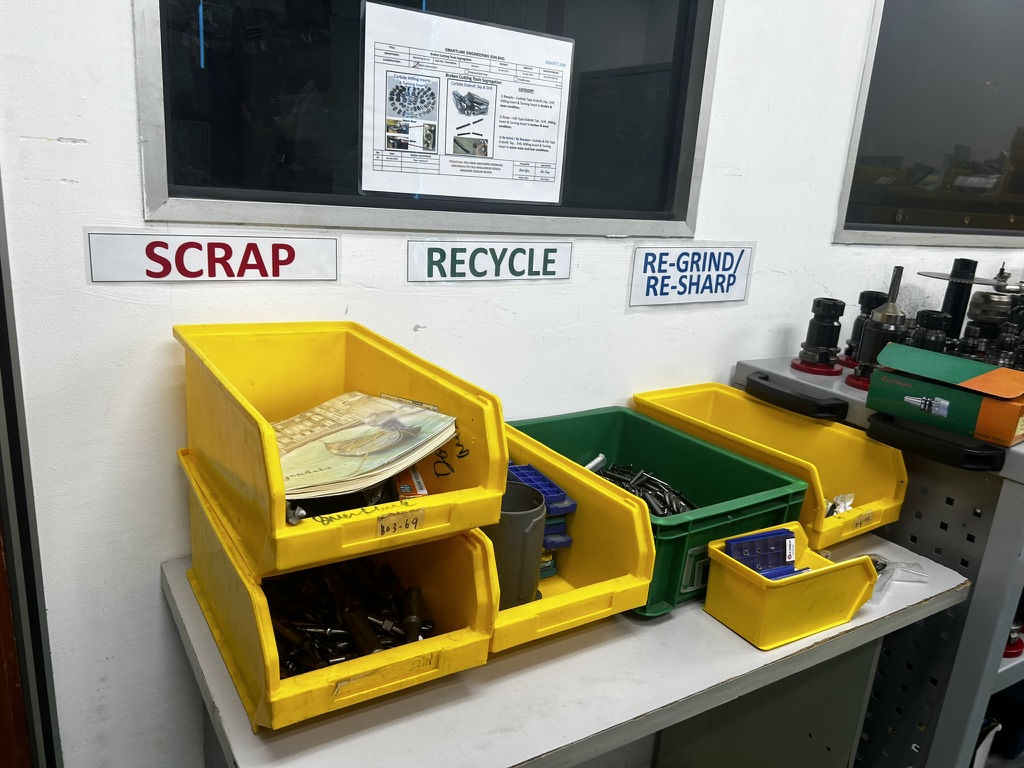
Without linked records, several questions remain unanswered:
- Has every borrowed cutter been returned?
- Was the tool worn out or simply no longer needed?
- Could it be reused or reground?
- Has the carbide scrap been collected for recycling?
The process then depends heavily on staff discipline and consistent manual recording. Even responsible employees can miss entries during busy shifts and handovers.
Manual control also carries a cost
Appointing an authorised person to receive every returned cutter may improve control, but someone must maintain the records, check incoming tools and follow up on outstanding items.
That requires ongoing staff time. If the employee resigns, recruitment, training and handover add further work.
Assigning returns to a supervisor or engineering manager creates another burden. Their attention is already needed for production, machining issues and product quality.
The question is therefore not simply whether a CNC machining workshop can control returns manually. It is how much time and effort it takes to maintain that control reliably.
Every cutter should come back—even scrap
A clear return policy gives every borrowed tool an accountable destination.
Partly used cutters should return for review. Worn tools should return for regrinding assessment. Broken or unusable carbide cutters should return for inspection and organised scrap collection.

Recycling value depends on the material, condition, quantity and recycler’s terms. But recovery begins with one basic requirement: the CNC machining workshop must get the tools back.
How SmartBeeBox helps
SmartBeeBox Helix X and Helix Pro support a simple policy: every borrowed cutter must be returned.
Operators log in using face identification, press Return, select a cutter from their outstanding borrowed tools and choose Regrind, Scrap, Change Product or Wrong Borrowing. They then place the cutter in the designated side return compartment.
Authorised staff can inspect the returned tools at planned intervals and decide what can be reused, reground or collected for recycling. This supports traceability and follow-up while reducing reliance on manual return entries.
As carbide costs rise, make every cutter count. Contact SmartBeeBox to explore better CNC cutting tool return control.